
“Sanctuary: creating culturally adaptive spaces”

Recently, I was in a conversation with friends and colleagues about differing food diets in congregational contexts.
Not only do we eat different foods, we have different food sensitivities.
Food is at once economic, political, spiritual, cultural, and personal.
We may not often think about where our food comes from or where it goes after we have thrown away leftovers. We also may not often think about how our food choices express values and cultural norms.
I am reminded of this almost every time I set foot in a local grocery store.
In our recent conversation, we were sharing about how people in congregations will adapt to each other’s food diets and how when one or two people may be vegetarian or vegan or gluten-free, other people in the congregation will adapt to that. People’s care for each other can be a lovely expression of belonging in a church.
I was also thinking about how culturally we can adapt with each other.
When I was in seminary, I interned at a small, historically Japanese American Presbyterian Church in Hollywood. The surrounding neighborhood had changed a lot since its beginning days, and by the time I arrived, it had become a largely Spanish-speaking neighborhood around the church. I was deeply moved by how the historically Japanese American congregation adapted and created culturally supportive spaces for Spanish-speaking families, particularly mothers and their children. They became, over time, a bilingual, English and Spanish speaking church. They also enjoyed a potluck lunch after the worship service each Sunday; everyone brought food from home to share, expressions of home cultures and values.
When we in churches, especially Anglo-Americans, are not accustomed to culturally adapting to people around us, but rather, are accustomed to everyone around us adapting to us, we will not have the awareness or the tools to adapt culturally and to create supportive spaces. Rather than creating sanctuaries, we may be creating cultural social clubs that only reinforce cultural assumptions, values, and behaviors, and we will in turn expect people to adapt to us.
First-generation immigrant communities have, I think very understandably, formed churches in the United States that speak their mother tongue and express their cultural values. Churches can be social, cultural, and spiritual centers for first-generation immigrant communities. Church is one of the few places where many first-generation immigrant communities can find some semblance of belonging, in a white supremacist society that prioritizes Anglo-American speech, bodies, and cultural norms.
Anglo-Americans, as part of a dominant culture, need to revisit time and time again the words in the New Testament letter of Philippians: “If, then, there is any comfort in Christ, any consolation from love, any partnership in the Spirit, any tender affection and sympathy, make my joy complete: be of the same mind, having the same love, being in full accord and of one mind. Do nothing from selfish ambition or empty conceit, but in humility regard others as better than yourselves. Let each of you look not to your own interests but to the interests of others.” (2:1-4).
Chapter two of Philippians includes what has become known as the “Christ hymn,” and in it we find the words, Christ “emptied himself.”
Self-emptying or in Greek kenosis is a significant theological idea and practice. Kenosis involves self-emptying of oneself in order to care for each other in the church community. Kenosis is humble self-giving.
For historically Anglo-American churches to create sanctuaries with culturally adaptive spaces, we will need to learn and re-learn kenosis. This self-emptying, I think, can take many forms – perhaps rethinking service times or language or rituals or music or attitudes or relationships between individuals and congregations. This is different from “celebrating” “cultural diversity” in which there continues to be a single dominant culture with a few “others” included. Self-emptying will require letting go of one’s own cultural prioritization. What will emptying ourselves of white supremacy look like and feel like?
What if we learn, over time, the attitude of feeling like we have nothing to lose and everything to gain by practicing cultural kenosis?
Is it possible?
We do, I believe, have everything to gain from practicing culturally adaptive sanctuaries, sanctuaries that continually undergo re-creation.
We will witness and experience firsthand the rich, ever-expanding, ineffable beauty of imago dei in community.
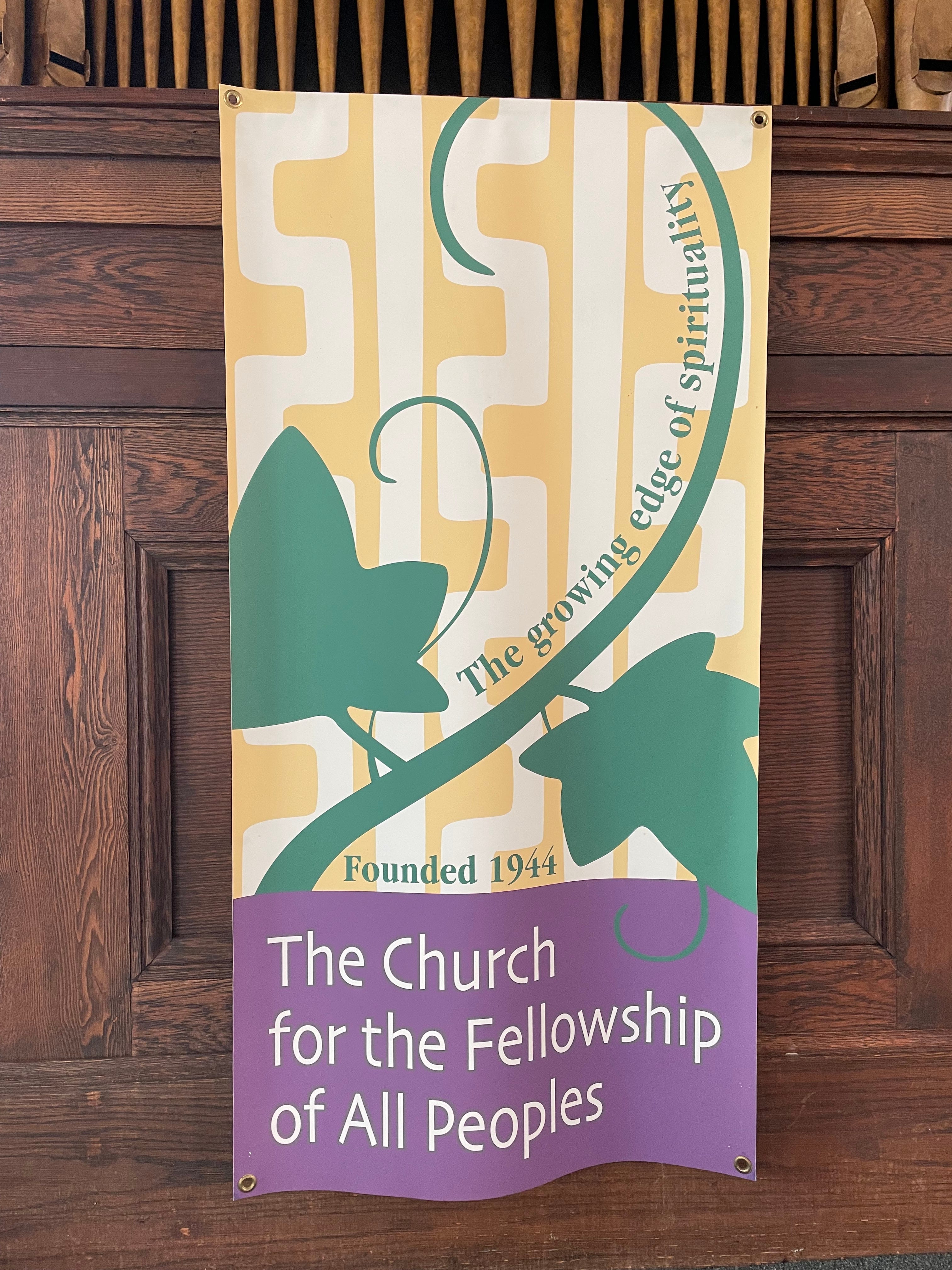
(Pictured: a banner at The Church for the Fellowship of All Peoples, San Francisco, C.A., November, 2021)
“What if we learn, over time, the attitude of feeling like we have nothing to lose and everything to gain by practicing cultural kenosis?” Yes! This is certainly not easy when we are set in our ways and biases. But how pleasing it would be to the One who created the diversity with unity in mind!!!